
Occupancy and utilisation are two of the most important metrics in workplace management. Both help organisations understand how their office space is being used, yet the terms are often used interchangeably. The distinction matters more than you might think. Knowing how many people are in an office tells you something about workplace demand. Understanding how effectively the available space is being used tells you much more about whether that space is meeting the organisation’s needs. Confusing the two can lead to poor planning decisions, wasted space and unnecessary costs. For organisations looking to make better use of their workplace, understanding the difference is an essential first step.
What Is Occupancy?
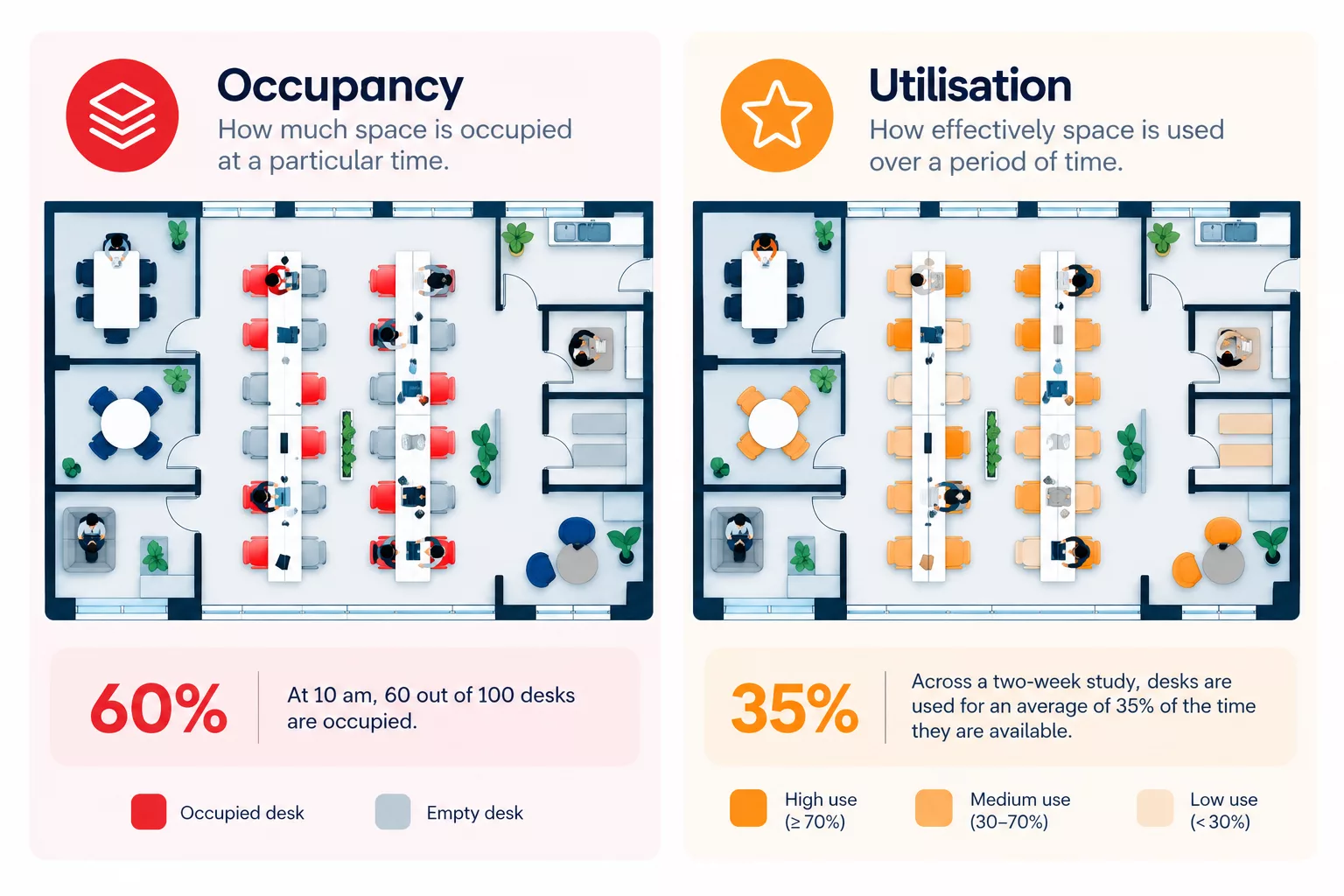
Occupancy describes the presence of people within a space, or the extent to which that space is occupied at a particular time. Depending on how it is measured, occupancy might tell you how many people are in a building, how many desks are occupied at a given moment, or what proportion of a room’s capacity is being used. For example, if an office has 100 desks and 60 are occupied at 10 am, desk occupancy at that moment is 60%. Occupancy data can help workplace managers identify busy periods, understand attendance patterns and see which areas of a building are attracting the most people. However, a single occupancy figure only tells part of the story. It represents a particular moment or measurement period and does not necessarily reveal how consistently the space is used throughout the day or week.
What Is Utilisation?
Utilisation measures how space or its capacity is being used relative to a defined benchmark, available capacity or period of time. In workplace management, utilisation can be measured in several ways. It might describe how frequently desks are used during available working hours, how much of a meeting room’s capacity is occupied, or how much of a building’s available space is actively used. The calculation depends on the metric being assessed, so it is important to understand exactly what a utilisation figure represents. Consider the same office with 100 desks. A snapshot shows that 60 desks are occupied at 10 am. But a two-week utilisation study might reveal that most desks are used only occasionally, with attendance concentrated on Tuesdays and Wednesdays and large areas remaining underused on other days. The snapshot helps explain what is happening at 10 am. The wider utilisation study helps explain how effectively the office is being used over time. That distinction is particularly important when making decisions about office capacity, workplace design and property costs.
Occupancy vs Utilisation: What’s the Difference?
Although the two measures are closely related, they answer different questions.
Occupancy asks: How much space is occupied, or how many people are present?
Utilisation asks: How effectively is the available space or capacity being used against a defined measure?
Occupancy is often used to understand presence and demand at a particular point in time. Utilisation helps organisations assess patterns of use and compare actual demand with the space available. Neither metric is inherently more valuable than the other. Their usefulness depends on the question being asked.
| Workplace question | What you need to understand |
|---|---|
| How many people are in the office today? | Occupancy |
| Which days are busiest? | Occupancy patterns over time |
| Are we providing more desks than employees need? | Utilisation, alongside peak demand |
| Are meeting rooms being used effectively? | Room utilisation, including booking and actual-use data |
| Could we reduce our office footprint? | Utilisation, peak occupancy, future demand and business requirements |
The key is to use the right metric for the decision you need to make.
Why Do Organisations Confuse Occupancy and Utilisation?
One reason is that workplace technology often presents different types of data in similar ways. A dashboard might display a percentage labelled occupancy or utilisation without making it clear what is being measured, how the figure was calculated or what period it covers. Another challenge is that organisations increasingly collect workplace data from multiple sources, including access control systems, desk booking platforms, sensors and room booking systems. These sources provide useful insights, but they do not all measure the same thing. Understanding their limitations is essential.
1. Assuming badge data shows how space is used
Access control data can show when people enter and leave a building. It is useful for understanding attendance patterns, but a badge swipe does not tell you where someone spends their time once inside. An employee might enter the office, spend most of the day in meetings and never use an assigned desk. Another might work at a desk for several hours without generating any additional access events. Badge data can help establish building attendance, but it cannot independently provide a complete picture of desk or room utilisation.
2. Treating bookings as actual occupancy
Desk and room booking systems show what people intend to use or have reserved. They do not necessarily confirm that the space was occupied. An employee might book a desk but work from home instead. A meeting room might be reserved for an hour but used for only 20 minutes, or not used at all. Without understanding the difference between a booking and actual use, organisations risk overestimating demand or overlooking opportunities to improve space allocation.
3. Assuming sensor data tells the whole story
Sensors can provide valuable information about presence and activity, depending on the technology deployed and how it is configured. However, a sensor reading is not automatically a complete measure of workplace utilisation. Coverage, detection limitations, the type of sensor and the period being analysed can all affect the results. For example, a sensor may detect presence at a desk but not explain whether the desk is being used efficiently over the working week. Equally, a room sensor may register occupancy without revealing whether the room is appropriately sized for the meeting taking place. Sensor data is most useful when its capabilities and limitations are understood and the results are interpreted in context.
4. Relying on a single snapshot
A building that appears quiet at 9 am might be busy by midday. An office that looks full on a Tuesday could be significantly underused on a Friday. A single observation can be useful, but it should not automatically be treated as representative of typical demand. Workplace attendance varies by day, time, team, location and working pattern. Understanding those variations is essential before making decisions about how much space an organisation needs.
What Goes Wrong When Occupancy and Utilisation Are Confused?
The consequences extend beyond inaccurate reporting. Misinterpreting workplace data can directly influence property costs, employee experience and long-term planning.
Paying for space you do not need
If organisations focus on peak occupancy without understanding how space is used across the week, they may assume they need more desks or a larger office than their typical demand requires. Conversely, looking only at average utilisation could lead to space being removed even though capacity is insufficient on the busiest days. The answer is not simply to increase or reduce space. It is to understand average demand, peak requirements and how space is distributed across the workplace.
Removing the wrong space
Low utilisation does not necessarily mean a space is unnecessary. A meeting room might be used infrequently but be essential for confidential discussions. Specialist facilities may have lower occupancy because they serve a particular function or require dedicated capacity. Before reducing space, organisations need to consider its purpose, availability requirements and business value, as well as the data showing how often it is used.
Creating a poor employee experience
Misunderstanding demand can lead to the wrong balance of desks, meeting rooms, collaboration areas and quiet spaces. An office may appear to have plenty of capacity overall, yet employees could struggle to find a suitable meeting room or a desk in the area they need. Looking at occupancy and utilisation together helps reveal not just whether space is available, but whether it is available in the right places and at the right times.
Making decisions based on incomplete evidence
Workplace strategies increasingly rely on data to support decisions about hybrid working, office design, property portfolios and sustainability. If the underlying measures are misunderstood, the conclusions drawn from them may be unreliable. A confident decision is not necessarily a well-informed decision. The quality of workplace planning depends on understanding what the data actually tells you, what it cannot tell you and what additional evidence is needed.
How to Use Occupancy and Utilisation Together
The most effective approach is not to choose between occupancy and utilisation, but to understand how they complement one another. Start by defining the question you need to answer. Are you trying to understand building attendance, identify peak demand, assess desk usage or determine whether your office footprint is appropriate? Different questions require different measures. Then combine the relevant data sources to build a more complete picture.
1. Measure occupancy to understand presence and demand.
Use appropriate access data, sensors or other attendance measures to understand when people are present and how demand changes throughout the day and week.
2. Measure utilisation to understand patterns of use.
Assess how frequently or effectively desks, meeting rooms and other spaces are used against a clearly defined capacity or time-based benchmark.
3. Compare actual use with bookings and planned capacity.
Comparing bookings with actual-use data can reveal no-shows, unused reservations and differences between intended and observed demand. Comparing usage with available capacity helps identify potential pressure points and opportunities to make better use of space.
4. Investigate the reasons behind the numbers.
Data can highlight where something is happening, but it does not always explain why. Manual observation studies can add valuable context by recording how spaces are used, what activities take place and what automated data may miss.
5. Use the combined evidence to make better decisions.
With a clearer understanding of occupancy, utilisation and the reasons behind the patterns, workplace managers can make more informed decisions about desk provision, meeting rooms, space allocation and future property requirements. The important point is to avoid treating any single metric as a complete answer. Each source provides a different perspective, and the greatest value comes from understanding how those perspectives fit together.
How Accordant Helps Organisations Understand Their Space
Understanding occupancy and utilisation requires more than collecting data. Organisations need to connect the information to an accurate picture of their workplace and use it to support practical decisions. Accordant by CadM brings workplace space information and management capabilities together, helping organisations understand their buildings, track how space is allocated and support better-informed workplace planning. For organisations that need a deeper understanding of how their offices are used, Accordant Anywhere supports manual observation studies. These can complement data from sources such as access control, bookings and sensors, providing additional context where automated measurements alone do not tell the full story. By bringing different sources of workplace evidence together, organisations can move beyond asking whether their offices are occupied to understanding how effectively their space supports the people and activities it serves.
Frequently Asked Questions
Is occupancy the same as utilisation?
No. Occupancy generally describes presence or the extent to which a space is occupied, while utilisation assesses how space or capacity is being used against a defined measure. The precise meaning depends on the metric and calculation being used.
Can occupancy data tell you whether an office is being used efficiently?
Not on its own. Occupancy data can show when people are present and help identify busy periods, but it may not reveal how consistently desks and rooms are used or whether the available space is appropriately allocated. Utilisation data and additional workplace context can help answer those questions.
What is the difference between occupancy and desk utilisation?
Desk occupancy usually refers to whether desks are occupied at a particular time or the proportion occupied within a defined area. Desk utilisation typically measures desk use against a defined benchmark, such as available desks over a working period. Organisations should always clarify the calculation behind their figures.
Can sensors measure workplace utilisation?
Sensors can provide useful evidence of presence and activity, depending on the technology and its configuration. However, sensor readings have limitations and may not explain the full context of how space is used. Combining sensor data with other sources, including bookings and manual observation, can provide a more complete picture.
Why should organisations measure both occupancy and utilisation?
Measuring both helps organisations understand current demand as well as patterns of space use. Together, these insights can support better decisions about office capacity, desk provision, meeting rooms and workplace design, reducing the risk of making costly decisions based on incomplete evidence.
Make Better Workplace Decisions with Better Data
Occupancy tells you something about who is present and when. Utilisation helps you understand how space is being used against a defined measure. Understanding the difference is fundamental to making informed workplace decisions. By combining the right metrics with reliable space information and appropriate observation, organisations can build a more accurate picture of their workplace and plan with greater confidence.
Discover how Accordant by CadM can help you understand your workplace with Space Management, Occupancy Tracking and Space Utilisation capabilities.