Artificial intelligence is rapidly reshaping workplace and space management. From predicting occupancy demand to optimising hybrid seating strategies, AI promises smarter, more cost-efficient real estate decisions. However, AI is only as powerful as the data feeding it. Before deploying AI within your space management software, you must first harmonise your workplace data. Without a unified data foundation, AI generates noise instead of insight.
Data Integration Is Not the Same as Data Harmonisation
Connecting workplace systems is an important first step towards AI readiness, but integration alone doesn’t guarantee that the information is useful.
Data integration brings information from different systems together. Data harmonisation ensures that information is consistent, comparable and understood in the same way.
For example, two offices might both report desk utilisation, but one calculates it using desk booking records while the other uses occupancy sensors. Although the figures appear comparable, they are measuring different behaviours.
Without harmonisation, AI may interpret these differences as genuine changes in workplace demand rather than differences in how the data was collected.
The objective isn’t simply to bring more data together. It’s to create a consistent foundation that allows information from different systems, buildings and regions to work together.
1. Break Down Data Silos Across Workplace Systems
In most organisations, workplace data sits in disconnected systems:
- Space management software (floor plans, seat assignments, capacity data)
- IWMS platforms (leases, costs, portfolio data)
- HR systems (headcount, department data)
- Badge access systems (actual attendance patterns)
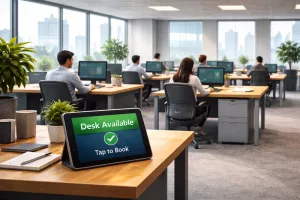
- Desk booking platforms (reservation behaviour)
- Observation-based studies
- IoT occupancy sensors (real-time occupancy information)
For example, your space management platform may show that a floor has 120 workstations assigned to the Marketing department. Meanwhile, badge data may reveal that only 55 employees enter that floor on peak days.
AI cannot reconcile these insights unless the systems are integrated and the information can be meaningfully compared.
By connecting these data sources into an integrated analytics layer, AI can detect underutilised zones, forecast hybrid attendance patterns and recommend consolidation opportunities.
The challenge is ensuring that each system contributes reliable, relevant information rather than simply creating a larger collection of disconnected data.
2. Standardise Space and Utilisation Definitions
Space management software often categorises space differently across regions. One building may classify collaboration rooms as “Huddle”, another as “Meeting Small”, and another as “Focus Pod”.
If AI is tasked with predicting collaboration demand, inconsistent naming will distort outputs.
To prepare:
- Standardise space types across your portfolio.
- Align utilisation formulas (e.g. reserved versus occupied versus badge-validated presence).
- Normalise departmental coding.
- Establish consistent definitions for desks, meeting rooms, collaboration areas and other space types.
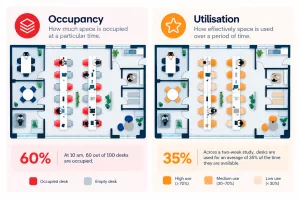
It is also important to distinguish between occupancy and utilisation.
Occupancy tells you who or what is present in a space at a particular time. Utilisation tells you how effectively that space is being used over a period of time.
For example, a desk may be assigned to an employee, booked for the day and yet remain unoccupied. These are three different data points, and AI needs to understand the distinction.
If utilisation in one region is calculated using sensor data and another uses booking data only, AI predictions for portfolio optimisation will be unreliable. Harmonisation ensures apples-to-apples comparisons.
3. Clean and Align Floor Plan Data
Many organisations assume their CAD or digital floor plans are accurate — until AI models begin generating anomalies.
Common issues include:
- Seats shown in the system that no longer exist.
- Departments occupying space that hasn’t been updated in the system.
- Duplicate or outdated workstation IDs.
- Mismatched capacity data.
- Changes to layouts that haven’t been reflected in the digital floor plan.
If your space management software shows 10,000 workstations but 1,200 are no longer active, AI forecasting tools will overestimate space demand.
A full audit of space inventory, capacity and allocation data is essential before AI deployment.
This also means ensuring that digital floor plans reflect the reality of the workplace. Accurate spatial information provides the foundation for understanding where people work, how space is allocated and how different areas perform.
Clean floor plan alignment dramatically improves the reliability of the information used for predictive analysis.
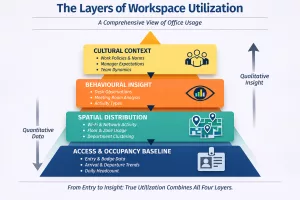
4. Integrate Booking, Sensor and Observational Survey Data
Modern AI-powered space management relies on understanding behavioural patterns rather than simply counting bookings or assigned desks.
Consider the following example:
- Desk booking software may show that 70% of employees reserve desks on Tuesdays and Wednesdays.
- Sensor data may reveal that 30% of booked desks remain unused.
- Badge data may show peak building entry at 10:00 AM but a sharp drop-off after 3:00 PM.
- Observation-based surveys may reveal that collaboration areas are consistently busier than individual workstations.
Each source provides a different perspective on how the workplace operates.
When these data streams are harmonised, AI can:
- Recommend reducing desk counts while maintaining service levels.
- Predict peak congestion zones.
- Identify discrepancies between bookings and actual attendance.
- Adjust hybrid capacity policies.
- Highlight areas that are consistently underutilised.
However, this requires synchronised timestamps, consistent identifiers across systems and appropriate API-driven data integration.
It also requires understanding the limitations of each data source. A booking does not necessarily mean a desk was occupied, just as a sensor reading alone may not explain why a space was being used.
Combining multiple sources provides a much more complete picture.
5. Connect Space Data to Financial Data
AI becomes especially powerful when space data integrates with financial information.
For example:
- Lease cost per square foot from your IWMS.
- Departmental seat allocation from space management software.
- Actual occupancy and utilisation data.
- Operational costs associated with maintaining different buildings.
AI can then help calculate cost per utilised seat — not just cost per assigned seat — revealing hidden inefficiencies.
This enables more informed strategic decisions such as consolidating floors, renegotiating leases, reallocating underused space or identifying opportunities to reduce operational expenditure.
By connecting workplace activity with financial performance, organisations can move beyond understanding how much space they have to understanding the value they are getting from it.
6. Establish Data Governance Within Space Platforms
Even the best software degrades without governance.
Workplace data is constantly changing. Employees move departments, teams change locations, floor plans are updated and new booking or sensor systems are introduced.
To remain AI-ready:
- Assign ownership for space data accuracy.
- Set quarterly validation cycles for floor plans.
- Establish naming conventions across global portfolios.
- Monitor data completeness and accuracy metrics.
- Define who can access and update different types of information.
- Establish appropriate privacy and data protection controls when combining employee, attendance and behavioural data.
AI models depend on reliable information. If incoming data becomes inconsistent, incomplete or outdated, the quality of the resulting insights will decline over time.
Data harmonisation is therefore not a one-off project. It requires ongoing management, clear responsibilities and consistent processes.
7. Start With a Targeted AI Use Case
Rather than harmonising everything at once, align your data improvement efforts with a clear objective.
Potential starting points include:
- Hybrid workforce forecasting.
- Portfolio downsizing analysis.
- Space demand modelling for business growth.
- Predictive workplace maintenance.
- Desk and meeting space optimisation.
For example, if your goal is hybrid seat optimisation, prioritise harmonising booking data, badge data and departmental headcount first.
Once these sources are reliable and connected, you can introduce additional information to improve the accuracy and sophistication of your analysis.
Starting with a defined use case also makes it easier to measure the value of your investment and demonstrate the benefits of becoming AI-ready.
The Bottom Line
Deploying AI within space management software is not a technology-first initiative — it is a data-first transformation.
Organisations that integrate, standardise, cleanse and govern their workplace data unlock the potential for AI-driven insights that reduce costs, improve employee experience and optimise portfolio strategy.
Those that skip harmonisation risk automating flawed assumptions.
Workplace management platforms play an important role in this process by providing a visual, structured environment for managing space, people, assets and workplace activity. When connected with other business systems and data sources, they can help organisations build the foundations for more intelligent workplace decisions.
The goal isn’t simply to collect more workplace data. It’s to make the information you already have work together.
In the age of intelligent workplaces, data harmony is your competitive advantage.
Frequently Asked Questions
Workplace data harmonisation is the process of bringing information from different workplace systems together and ensuring it uses consistent definitions, formats and standards. This allows organisations to compare information accurately across buildings, departments and regions.
AI relies on accurate, consistent and relevant information to identify patterns and generate predictions. Incomplete, duplicated or inconsistent data can lead to misleading insights and unreliable recommendations.
Common sources include space management software, IWMS platforms, HR systems, desk booking platforms, badge access systems, occupancy sensors and observational survey data. The most important systems will depend on the intended AI use case.
Space management software provides structured information about floor plans, workstations, space allocation, capacity and departmental assignments. When connected with other workplace systems, it helps create a more complete picture of how buildings and spaces are being used.
Occupancy measures presence in a space at a particular time, while utilisation measures how effectively that space is used over a period of time. Both provide valuable but different insights, and combining them helps organisations make better workplace decisions.
Start by auditing existing systems, standardising space classifications, validating floor plans, removing duplicate records and establishing clear data ownership. Regular reviews and consistent governance processes help maintain data quality over time.