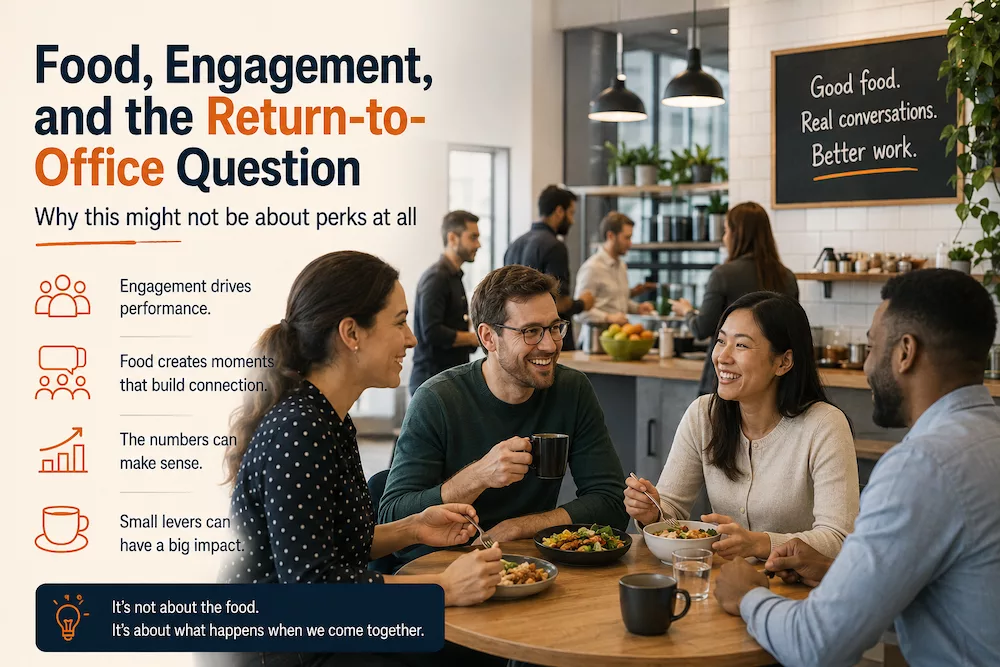
Why this might not be about perks at all
As organisations continue to navigate return-to-office decisions, most of the conversation has centred on where people work. Office versus home. Hybrid versus fully remote. Mandates versus flexibility.
A more interesting — and arguably more useful — question sits underneath all of this: what actually makes being together valuable in the first place?
This piece explores a simple, slightly unexpected idea: could something as ordinary as workplace food play a small but meaningful role in productivity?
Using a mix of engagement research and straightforward economic framing, a few observations begin to emerge:
- Engagement has a measurable and repeatable impact on performance.
- Food isn’t just a perk; it can subtly shape behaviour, presence, and interaction.
- Even deliberately extreme food programmes are not obviously irrational when modelled.
- More typical approaches require surprisingly little improvement to justify the cost.
The point is not that food drives productivity in any direct or mechanical sense.
It’s that it may help create the conditions in which engagement — and therefore performance — is more likely to improve.
Engagement is one of those “soft” things that isn’t really soft
Engagement is often discussed in the language of culture: morale, satisfaction, sentiment. As a result, it can be dismissed — or at least deprioritised — when organisations focus on harder financial metrics.
But the evidence has been remarkably consistent for years. Large-scale studies across industries show that highly engaged teams outperform less engaged ones across multiple dimensions. Productivity improves, error rates fall, customer outcomes strengthen, and retention tends to follow.
What’s easy to overlook is that disengagement is not passive. It is not simply the absence of effort. It has a direction, and often a cost.
Disengaged employees are more likely to withdraw, to contribute less than they are capable of, and to disconnect from the broader goals of the organisation. Over time, this shows up in ways that are both visible and measurable — slower delivery, weaker collaboration, and higher turnover.
So while engagement is often labelled as “soft,” it behaves much more like an economic variable.
It moves, and when it moves, other things tend to move with it.
If that’s true, the practical question becomes: what actually shifts engagement in a reliable way?
Food as a quiet behavioural nudge
Food is rarely discussed in serious workplace strategy conversations. When it is, it tends to be framed as a perk — something nice to have, but ultimately non-essential.
And yet, in practice, food has always influenced behaviour at work. The difference is that in many cases, this influence has been incidental rather than intentional.
Some organisations — particularly in the technology sector — have treated food more deliberately. Not as a reward, but as a tool for shaping how people spend time, where they go, and who they interact with during the day.
The mechanism is subtle. Food doesn’t force behaviour, but it reduces friction and creates default patterns.
For example:
- Reduced friction — fewer decisions about where to go, what to eat, or how long to spend away from work
- Increased overlap — more people in the same place at the same time, especially during peak hours
- Informal interaction — conversations that happen without scheduling, often across teams or levels
- Attendance incentives — a small but tangible reason to come into the office in hybrid environments
One of the more interesting observations is that café-style spaces often outperform carefully designed “collaboration areas.” The difference is that cafés provide a socially natural reason to be there. People don’t go to collaborate — they go to eat or get coffee — and collaboration happens as a by-product.
That distinction matters. Designed collaboration can feel forced. Shared routines tend to feel effortless.
Seen this way, food is less about provision and more about pattern-setting. It creates repeatable moments where people cross paths, and where useful, low-friction interactions can occur.
A deliberately extreme thought experiment
To understand whether any of this holds up economically, it helps to start with a deliberately exaggerated scenario. Not because it’s realistic, but because it defines the outer boundary of what might be plausible.
Imagine an organisation with:
- 1,000 employees
- $100 per employee, per day, spent on food
- Full attendance, five days a week
This results in an annual cost of roughly $25 million.
Assume a typical knowledge-work benchmark:
- Revenue per employee: $200,000
- Total revenue: $200 million
To justify the food spend purely on productivity grounds, the organisation would need to see a 12.5% improvement in output.
At first glance, that feels implausibly high. But it becomes more interesting when placed alongside engagement research, where the performance gap between low and high engagement often falls somewhere in the mid-teens.
The implication here is not causal. It’s not that food creates a 12.5% uplift.
It’s that the scale of improvement required is not entirely disconnected from known variations in performance.
In other words, even an intentionally overstated version of the idea does not immediately collapse under scrutiny.
What happens when you dial it back
Of course, very few organisations would — or should — operate at that level of spend. A more grounded scenario looks quite different, and much closer to what many companies already experiment with.
For example:
- $10–15 per employee, per in-office day
- Average attendance of 2–3 days per week
- Same 1,000 employees
At a midpoint of $12 per day, this equates to roughly $1.5 million annually.
Set against $200 million in revenue, the required productivity improvement drops to around 0.75%.
At that level, the conversation changes. The question is no longer whether food can transform performance, but whether it can contribute to small, cumulative improvements.
Those improvements don’t need to be dramatic. They might show up as:
- Slightly higher attendance on the days that matter most
- Faster onboarding through proximity and informal guidance
- Reduced early-career attrition due to stronger social integration
- Incremental gains in collaboration and knowledge sharing
Individually, each of these effects is modest. Collectively, they may be sufficient.
And importantly, they align with mechanisms we already understand — proximity, repetition, and informal learning.
A useful reality check
It’s important not to overstate the role of food in any of this.
Food does not create engagement on its own, and it does not compensate for weak leadership, poor management, or unclear strategy. In the wrong environment, it becomes an expense with very little return.
Its effectiveness is highly dependent on context and execution, including:
- Whether physical spaces are designed to support lingering and interaction
- Whether hybrid working patterns create meaningful overlap
- Whether leaders are present and participate in shared spaces
- Whether the culture allows informal, unstructured interaction to happen
Without these conditions, food remains transactional — consumed and forgotten.
With them, it can function more like infrastructure: a consistent, low-effort way of increasing the frequency and quality of human interaction.
A different way to think about return-to-office
Many return-to-office strategies have been framed around control — policies, mandates, minimum attendance requirements. These approaches tend to generate friction, and in some cases, quiet resistance.
An alternative framing is economic rather than procedural.
Instead of asking where should people work, the more productive question may be:
under what conditions does working together create more value than working apart?
That shifts the focus from compliance to design.
From that perspective, workplace food becomes less about generosity and more about experimentation. It is one of the simplest levers available — relatively easy to implement, easy to adjust, and straightforward to measure.
It will not, on its own, resolve the complexities of hybrid work.
But it offers a practical way to test a broader idea:
That small changes in how people come together may have outsized effects on how work gets done.