
Ask most people which space is underused and they’ll point to desks. Rows of empty chairs have become the visual shorthand for waste.
In reality, desks are rarely the biggest issue.
The most underused spaces are usually the ones that almost work.
- Large meeting rooms booked “just in case”
- Specialist rooms no one feels confident using
- Collaboration areas that look impressive but don’t support real tasks
- Phone booths that feel awkward for longer conversations
- Quiet zones positioned next to the busiest walkways
They’re not obviously broken. They’re just slightly misaligned.
The “Almost Works” Problem
Underuse is rarely about laziness or lack of demand. It’s about friction.
People avoid spaces that are:
- Hard to access
- Difficult to book
- Poorly equipped
- Socially uncomfortable
- Unclear in purpose
When friction exists, behaviour adapts.
People crowd into familiar areas.
They default to desks.
They compromise — not because it’s ideal, but because it’s easy.
Over time, this creates a subtle pattern: some spaces feel permanently busy, while others quietly gather dust.
The Beautiful but Unusable Breakout
Every office seems to have one.
The beautifully designed breakout area.
The sculptural collaboration pod.
The soft seating cluster that looks like it belongs in a design magazine.
And yet — it’s empty.
Or worse: it’s being used as a temporary coat rack.
These spaces are often created with the best intentions. They signal creativity. They show investment. They make the office feel modern and inviting.
But functionally, they often struggle.
Common issues include:
- Positioned directly on a main circulation route
- Surrounded by visual and acoustic distractions
- No nearby screens or power access
- Seating that looks comfortable but isn’t practical for laptops
- No clear signal about whether the space is for quick chats or focused collaboration
When placed in the busiest part of the office, these areas become performance spaces rather than workspaces. People feel exposed. Conversations feel public. Screens are visible. Noise bleeds in.
So behaviour adapts again.
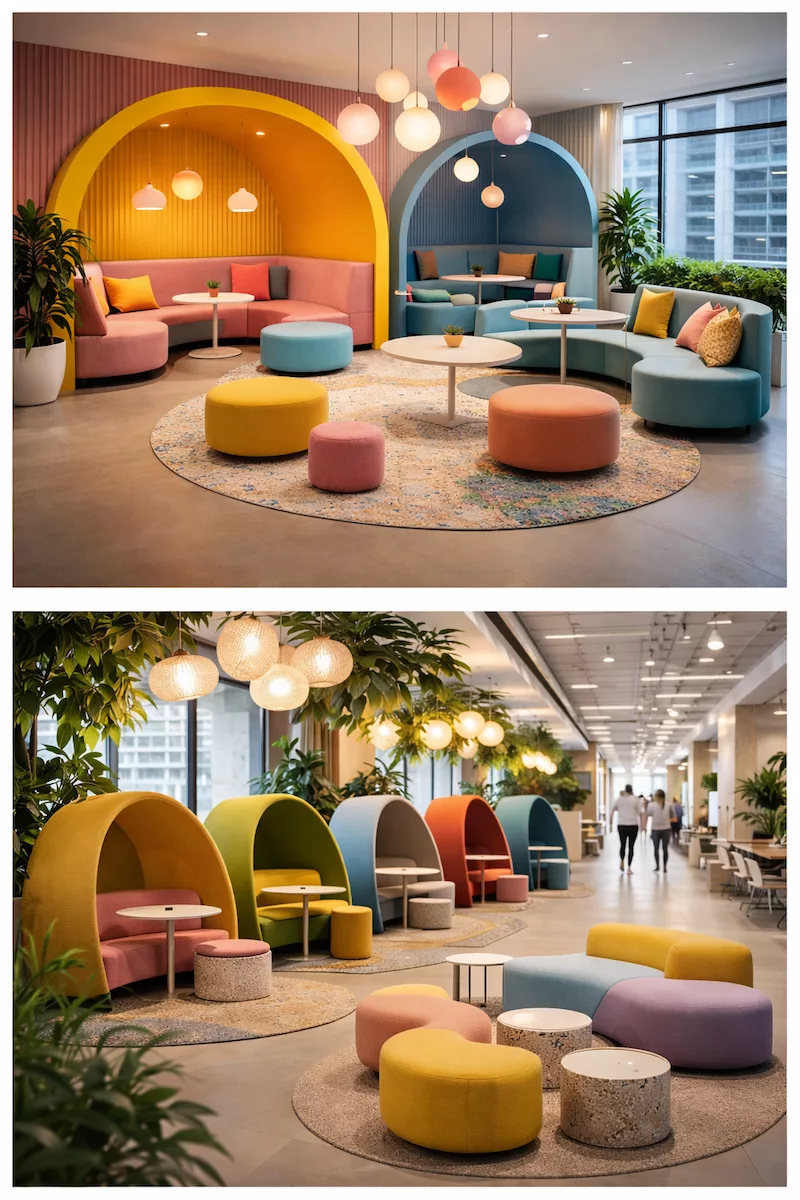
Instead of using the “collaboration pod,” teams retreat to a conventional meeting room with a door — even if it’s oversized.
Instead of holding a breakout discussion in the open lounge, they stay at their desks and speak quietly.
The irony is that these areas are often designed to encourage spontaneous interaction. But spontaneity still requires psychological comfort.
If a space feels like a stage, people won’t rehearse there.
Data often reveals the pattern clearly:
- Short, infrequent usage
- High pass-through traffic but low dwell time
- Peak use only when meeting rooms are unavailable
The issue isn’t that breakout spaces are unnecessary. It’s that aesthetics and placement matter just as much as intent.
Well-performing collaboration areas tend to share a few traits:
- Slightly offset from main traffic routes
- Clear acoustic boundaries
- Easy access to power and screens
- Obvious cues about purpose
- A balance between visibility and privacy
The most successful ones don’t shout for attention. They quietly support the work they’re meant to host.
Because ultimately, good workplace design isn’t about how a space photographs.
It’s about whether people choose it — even when no one is watching.
The Psychology of Avoidance
What makes this tricky is that underused space rarely generates complaints.
People don’t submit tickets saying, “This collaboration area lacks psychological safety.”
They don’t log requests stating, “The technology in Meeting Room 4 makes me anxious.”
They simply stop using it.
Avoidance is quiet. It shows up in behaviour, not feedback.
And because the space looks modern — perhaps even expensive — it’s easy to assume the issue is attendance, not design.
Data Tells a Different Story
This is where workspace management becomes genuinely insightful.
When organisations move beyond headline occupancy numbers and look at patterns — duration of bookings, group sizes vs. room capacity, peak vs. non-peak use, repeat no-shows — a different picture emerges.
For example:
- 10-person rooms regularly used by 3 people
- Collaboration zones used for solo laptop work
- Phone booths booked for two-hour “deep work” sessions
- Entire areas that spike in use on Tuesdays and sit empty on Thursdays
The insight isn’t that space is “wrong.”
It’s that behaviour is rational — even when design assumptions aren’t.
Small Adjustments, Big Shifts
Fixing underuse rarely requires adding more space.
Often it means:
- Rebalancing room sizes
- Simplifying booking rules
- Improving equipment reliability
- Clarifying intended use
- Adjusting adjacency (moving quiet space away from traffic)
- Reducing choice where too much variety creates hesitation
Sometimes the solution is as simple as renaming a room or redefining its purpose. Sometimes it’s resizing — turning one oversized meeting room into two right-sized ones.
Evidence-led tweaks often outperform expensive redesigns.
The Real Measure of Success
The most effective offices aren’t the fullest ones.
They’re the ones where space quietly supports work — without forcing people to adapt around it.
Underused space isn’t always obvious.
It’s rarely dramatic.
But it’s almost always revealing.
And if you look closely, the space people avoid often tells you more than the space they fill.